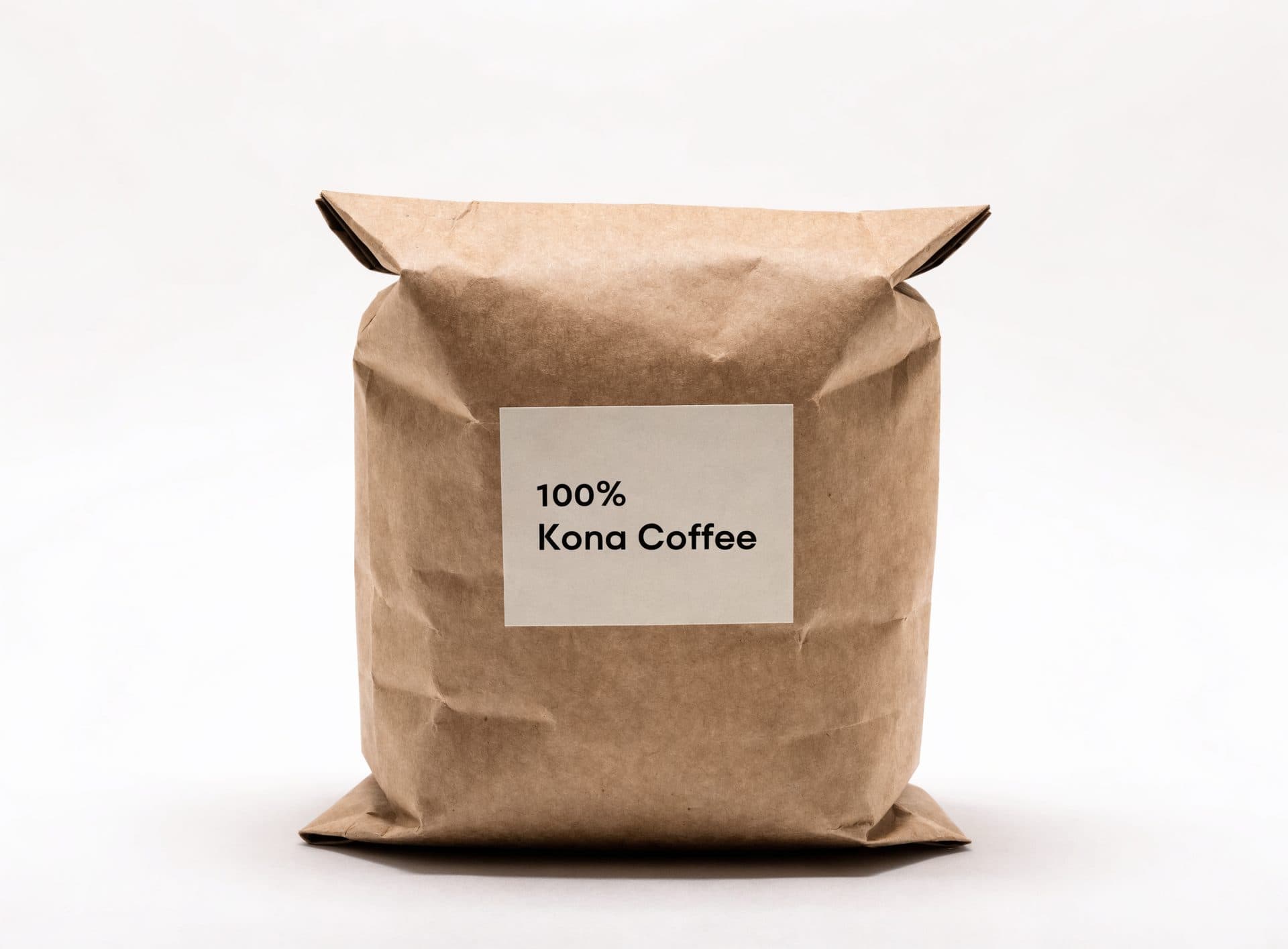
Illustration — not a named farm.
04
How to read a Kona bag
The bag is trying to sell you a feeling. Your job is to read the words that are doing legal work, then the words that are doing farm work, then the date, then the price. Photos of volcanoes are optional.
Read in this order
- Identity line — “100% Kona Coffee,” or stop.
- Farm, estate, or mill you can actually look up.
- Roast date, not only a best-by from next year.
- Grade words last (Extra Fancy, Fancy, No. 1, Peaberry). Sorting, not flavor. They do not rescue a blend.
- Price as a smell test. Genuine 100% Kona on farm sites commonly $30–$60+/lb.
The identity line
Look for the words “100% Kona Coffee.” That is the sentence that means the beans grew in the Kona district. Not “Kona blend.” Not “Kona coffee blend.” Not “made with Kona.” Not a huge KONA and a tiny percent in the corner. Blend percentage disclosure is already required under HRS §486-120.6 / Act 198, so if it is a blend, the percent should be on the identity statement. The identity statement is supposed to tell you the percent and the name (Kona coffee blend, and what else is in it). Until 30 June 2027 that percent can be as low as 10. From 1 July 2027, using a Hawaiʻi geographic name means at least 51% from that origin. Either way, 10% is not the cup you think you bought. If it says 10% Kona coffee blend, believe it. Nine tenths of what you brewed did not grow in Kona. If those 100% words are missing, stop. You already know what it is.
“Kona-style” and “Kona roast” are not origin claims. They are style language. They can sit on coffee that never grew in Kona. Treat them like “French roast.” Useful for color, useless for place.
Hawaiian blend is not Kona either. Kaʻū, Maui, Kauaʻi, and mixed Hawaiʻi lots deserve their own names. If you wanted Kona and the bag says Hawaiian, you are in the wrong aisle. More: Kona vs the rest of Hawaiʻi.
Farm, estate, mill
A named farm or estate is the next tell. You should be able to look the name up and find a real place on the west side of Hawaiʻi Island (or a mill that is honest about lots). “Estate” on Kona bags is a common farm word. It is not a magic HDOA grade by itself. It usually means this is the farm’s coffee, sometimes a mix of their top sorted lots. Still require the 100% line. A pretty farm story on a 10% blend is still a 10% blend.
If there is no farm, no mill, and no one who will say who grew it, you are buying a brand, not a field. That can still be 100% Kona if the identity line says so. It is a weaker paper trail.
Roast date vs best-by
Roast date tells you when the coffee became coffee you can brew. Best-by tells you when a warehouse is willing to keep selling it. For a nice washed Kona, you want the roast date. Fresh enough to smell like coffee when you open it, not so old that the bag is a souvenir. If the only date is a best-by a year out and the beans smell tired, you are paying Kona rent on stale inventory.
Who roasted it matters for the same reason. Farm-roasted or a named Hawaiʻi roaster is a clearer chain than an unsigned private label. Details on that split live in farm-direct vs the supermarket bag. On the bag in your hand, just ask: does anyone take care of this roast in public?
Grade words, used practically
HDOA green-coffee grades you will actually see on bags include Extra Fancy, Fancy, No. 1, and Peaberry. Those words are about how the green beans were sorted (size, uniformity, defects), not a tasting-note guarantee.
- Extra Fancy — the top Type I grade people reach for.
- Fancy and No. 1 — still real Kona grades, not a scandal.
- Peaberry — a different shape (one round bean in the cherry instead of two flat sides), not a secret extra rank of Extra Fancy.
We are not going to pretend a grade sheet is a flavor sheet. A well-roasted No. 1 can drink better than a stale Extra Fancy. Grade is a sorting signal. Origin and roast date still do more work in the cup. And none of the grade words rescue a blend. Extra Fancy printed on a 10% Kona coffee blend describes, at best, the Kona fraction, and sometimes just the vibe.
Price as a tell
Genuine 100% Kona on farm sites commonly shows up around $30–$60+/lb. That is the range people see, not a certified floor. Cheap “Kona” is usually a blend. If the bag is priced like breakfast blend and branded like a vacation, believe the price. If a farm is running a legitimate sale on 100% lots, the 100% wording and the farm name should still be there.
The whole literacy test
If you want a bag, start with 100% Kona from a named estate, roasted on a date you can read. That is the whole literacy test. The rest is scenery.
Stop here if:
- The 100% words are missing.
- It says Kona-style or Kona roast and nothing else that is an origin claim.
- You wanted Kona and the bag says Hawaiian.
- The price looks like supermarket coffee and the word looks like a postcard.
Then brew it: Pour-over vs drip for Kona once the bag is honest, or Farm-direct vs the supermarket bag if you are still staring at a tin.
FAQ
- What is the first line I should read?
- “100% Kona Coffee.” Not “Kona blend,” not “made with Kona,” not a huge KONA and a tiny percent. If those 100% words are missing, stop. You already know what it is.
- Does “estate” mean Extra Fancy?
- No. “Estate” on Kona bags is a common farm word. It is not a magic HDOA grade by itself. Still require the 100% line. A pretty farm story on a 10% blend is still a 10% blend.
- Roast date or best-by?
- Roast date tells you when the coffee became coffee you can brew. Best-by tells you when a warehouse is willing to keep selling it. For a nice washed Kona, you want the roast date.
- What do Extra Fancy, Fancy, No. 1, and Peaberry mean?
- HDOA green-coffee grades about how the beans were sorted (size, uniformity, defects), not a tasting-note guarantee. Extra Fancy is the top Type I grade people reach for. Fancy and No. 1 are still real Kona grades. Peaberry is a different shape, not a secret extra rank of Extra Fancy. None of them rescue a blend.
- Are “Kona-style” and “Kona roast” origin claims?
- No. They are style language. Treat them like “French roast.” Useful for color, useless for place.